

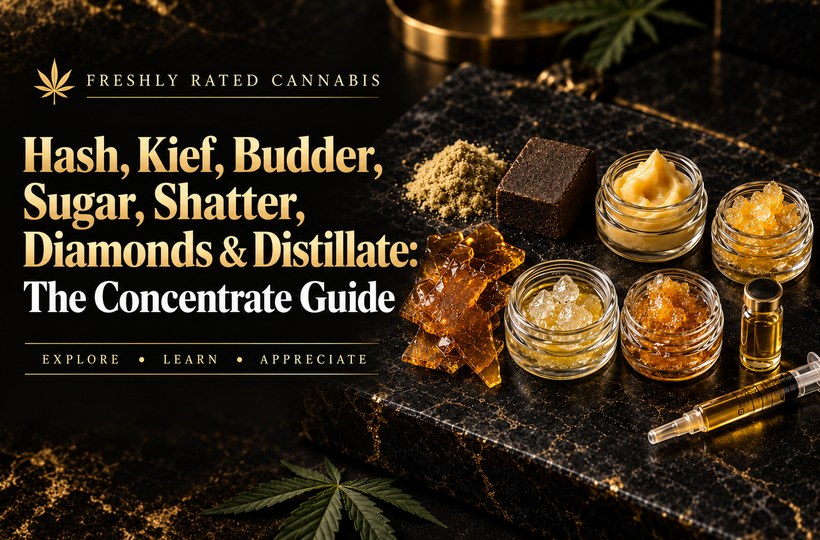
Open any concentrate menu in BC and you’ll find a dozen names for what looks like the same amber substance. Shatter, budder, sugar, crumble, caviar, diamonds, distillate, hash, kief. Most guides just define each one and leave you no wiser about which to actually buy.
So here’s the shortcut first: almost every concentrate on the menu is one of three things — trichomes separated mechanically, an extract made with solvent, or a refined oil with everything stripped out. Once you know which family a product belongs to, its texture, flavour, price and potency all follow. This guide sorts all of them into those three families and tells you which to pick.
The one distinction that explains the whole menu
Solventless concentrates (kief, hash, rosin) separate trichomes using nothing but ice, water, screens, heat and pressure. Lower potency, full plant character, nothing added.
Solvent-based concentrates (shatter, budder, sugar, crumble, live resin, diamonds) use butane or propane to dissolve the resin, then purge the solvent off. Much higher potency, more textures, more processing.
Refined concentrates (distillate) go further still, stripping out everything except the cannabinoid. Highest purity, zero flavour.
Neither solvent nor solventless is automatically “better.” Properly purged solvent extracts are clean and potent; solventless products taste like the plant they came from. It’s a preference, not a hierarchy — though anyone uneasy about residual solvent has an obvious lane in hash and kief.
First, a potency reality check
Good flower runs roughly 15–30% THC. Most concentrates run 60–90%+. That’s not a modest step up, it’s three to five times the strength by weight.
Which means the serving size is nothing like a bowl of flower. A beginner dab is the size of a grain of rice — genuinely, that small. If you’re coming from flower and you load what feels like a reasonable amount, you have loaded far too much. Start smaller than looks sensible and wait.
The solventless family
Kief
The simplest concentrate there is. Kief is the loose trichome powder that falls off flower through a fine screen — the stuff collecting in the bottom chamber of your grinder is the same thing. No solvents, no heat, no processing at all.
- Potency: roughly 20–50% THC, depending on how cleanly it was sifted
- Texture: dry sandy powder, pale gold to light brown
- How to use it: sprinkle over a bowl, roll into a joint, or press it into hash. No rig required.
- Best for: the easiest possible first step into concentrates
Kief degrades faster than other concentrates, so keep it sealed and cool. Browse kief.
Hash
The oldest cannabis concentrate in the world, and still one of the best. Hash is trichomes collected and compressed into a block — either dry-sifted and pressed (traditional Afghan, Moroccan, Lebanese styles) or separated in ice water and dried, which is bubble hash.
- Potency: roughly 20–60% THC
- Texture: pliable brown or blond block; softens with warmth
- How to use it: crumble into a joint or bowl, or dab quality bubble hash
- Best for: a warmer, rounder, more traditional high than modern extracts give you
Hash has a distinct character — heavier and more body-focused than a bright terpene-forward extract. Regions differ genuinely: Moroccan blond tends lighter, Afghan black heavier. Browse hash.
The solvent family: same extract, different textures
Here’s the part most menus obscure. Shatter, budder, sugar and crumble are frequently the same extraction, finished differently. Whether it ends up glassy, creamy, grainy or dry comes down to how much it was agitated, at what temperature, and how long it was purged.
So texture is mostly a preference, not a quality ranking. Which brings us to the biggest misconception in this whole category — covered further down.
Shatter
Hydrocarbon extract left undisturbed as it purges, so it sets into a translucent amber sheet that snaps like glass. Typically 70–90% THC, with relatively low terpene content because the stability that makes it glassy comes at the cost of some volatiles.
It’s easy to handle, easy to portion and stores well. We go deeper in what shatter is and how it’s made. Browse shatter.
Budder and badder
The same extract, whipped during the purge. Agitation clouds it and creates a creamy, cake-batter consistency. Typically 70–90% THC, and it tends to hold more terpenes than shatter — so it usually tastes better.
Much easier to scoop onto a dab tool than shatter, which is why a lot of regular dabbers prefer it. See our guide to cannabis wax or browse budder.
Sugar
Wet, grainy and crystalline — small THCA crystals suspended in a terpene-rich oil. It looks like damp brown sugar, and that texture is the extract naturally separating rather than a defect.
Sugar is usually one of the more flavourful solvent concentrates, because the liquid fraction is where the terpenes live. Slightly messier to handle. Browse sugar.
Crumble
Purged longer at low heat until it dries into a brittle, honeycomb-like solid that breaks apart in your fingers. Typically 60–90% THC with lower terpene content, since the extended purge drives off volatiles.
The dry texture makes it the easiest concentrate to sprinkle into a joint or over a bowl. Stock rotates — see what’s in at the moment across our concentrates.
Live resin
Not a texture but a starting material. Live resin is extracted from cannabis frozen fresh at harvest rather than dried and cured, which preserves terpenes that would otherwise evaporate. It’s the flavour benchmark of the solvent category, and it costs accordingly.
We compare it head to head in live resin vs shatter. Browse live resin.
The potency end: diamonds and sauce
Diamonds are crystallised THCA, grown by letting an extract sit under controlled pressure and low heat for days or weeks while the cannabinoid separates out of solution. In pure crystal form they can exceed 99% THCA — about as concentrated as cannabis gets.
They’re usually sold sitting in the terpene-rich liquid they separated from, which is where “diamonds and sauce” comes from. The crystals bring the potency; the sauce brings the flavour. On its own, a diamond has almost no smell.
Worth understanding: THCA isn’t intoxicating until heat converts it to THC. That’s why diamonds must be dabbed or vaped — eating one does very little. Browse diamonds.
The odd one out: distillate
Distillate is extract refined through repeated distillation until only the cannabinoid remains — typically 90%+ THC, and completely odourless and flavourless. Every terpene, flavonoid and minor cannabinoid has been removed by design.
That makes it the industrial workhorse of the cannabis world: it’s what fills most vape cartridges, what goes into most gummies and chocolates, and what tinctures are built from. It’s already decarboxylated, so it works in edibles without further heating.
Two things worth knowing. First, because distillate has no flavour of its own, any flavour in a distillate product was added back afterwards — sometimes cannabis-derived terpenes, sometimes botanical ones. Second, potency and experience aren’t the same thing: many people find high-percentage distillate a flatter, more one-dimensional high than a lower-testing live resin, because the terpenes shape the effect and not just the taste. Browse distillate.
Concentrate comparison chart
| Type | Method | Typical THC | Flavour | Texture | Best for |
|---|---|---|---|---|---|
| Kief | Solventless | 20–50% | Good | Dry powder | Easiest entry, no rig |
| Hash | Solventless | 20–60% | Distinctive | Pliable block | Traditional, warmer high |
| Shatter | Solvent | 70–90% | Modest | Glassy sheet | Clean handling, value |
| Budder | Solvent | 70–90% | Good | Creamy | Easy scooping, daily dabbing |
| Sugar | Solvent | 60–85% | Excellent | Wet crystals | Flavour on a budget |
| Crumble | Solvent | 60–90% | Modest | Dry honeycomb | Sprinkling into joints |
| Live resin | Solvent (fresh-frozen) | 65–90% | Best in class | Sticky, saucy | Flavour chasers |
| Diamonds | Solvent (crystallised) | 90–99% THCA | From the sauce | Crystals in oil | Maximum potency |
| Distillate | Refined | 90%+ | None (added back) | Clear oil | Carts, edibles, tinctures |
Three things people get wrong
1. “Shatter is stronger because it looks purer”
Clarity is a physical property, not a potency measure. Shatter is transparent because it was left still while it set; budder is opaque because it was whipped. Run the same extract two ways and they’ll test within a few points of each other. Choose texture on handling and flavour, not on looks.
2. “Highest THC percentage means best experience”
A 99% diamond with no sauce and a 70% live resin are different experiences, and plenty of experienced consumers prefer the second. Terpenes shape how a high feels, not merely how it tastes. Chasing the biggest number on the label is the most common way to spend more and enjoy it less.
3. “You need a dab rig to try concentrates”
You don’t. Kief on a bowl, hash crumbled into a joint, crumble sprinkled along a rolling paper — all of it works with equipment you already own. Buying a rig before you know whether you like concentrates is backwards.
How to actually use them
No equipment needed
- Top a bowl: pack flower, sprinkle kief or crumble on top, light the edge rather than the middle
- Twax a joint: run a thin line of warmed hash or a little shatter along the inside of the paper before rolling
- Roll hash into a snake: warm it in your fingers, roll it thin, lay it alongside the flower
Anything you add this way will make the joint burn slower and hit considerably harder. Use less than feels right.
Dab pens and cartridges
The middle ground: portable, no torch, and far less to go wrong. Wax pens take stable textures like shatter, budder and crumble. Prefilled 510 cartridges are almost always distillate, sometimes live resin.
Dab rigs and temperature
Temperature matters more than almost anything else, and it’s where beginners go wrong most often. Too hot and you burn off the terpenes you paid for, scorch your throat, and degrade the cannabinoids.
| Temperature | Result |
|---|---|
| 450–550°F (230–290°C) | Low temp. Best flavour, smooth vapour, small clouds. Start here. |
| 550–600°F (290–315°C) | Mid. Balanced flavour and vapour. |
| 600°F+ (315°C+) | High. Big clouds, harsh, flavour destroyed, concentrate wasted. |
| Glowing red nail | Far too hot. Degrades cannabinoids and produces genuinely unpleasant, irritating vapour. |
Without a temperature-controlled e-rig, the standard approach is to heat the nail for around 30 seconds and then let it cool for 20–30 seconds before dabbing. If the nail is still glowing, wait.
Dosing and safety
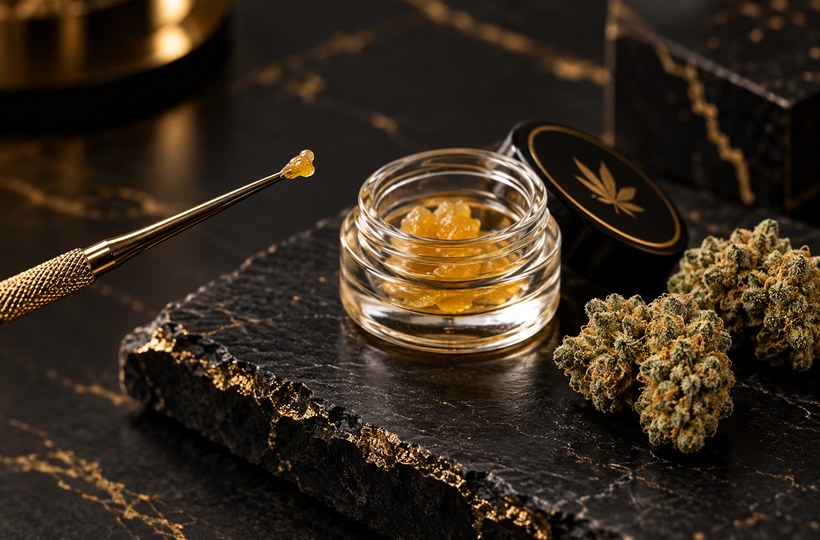
- Start with a grain of rice. Wait ten minutes before deciding whether you want more. Onset is fast, but it isn’t instant.
- Sit down first. Dizziness and a racing heart are common when you overdo a dab, and standing at a hot rig is the wrong place to discover that.
- Concentrate tolerance builds fast. Daily dabbing raises your baseline quickly, and coming back down is uncomfortable. Plenty of people keep concentrates as an occasional thing for exactly this reason.
- Buy from somewhere that can tell you how it was made. Badly purged hydrocarbon extract leaves residual solvent behind. If a shop can’t answer basic questions about its source, that’s the answer.
Never attempt hydrocarbon extraction at home. Butane is heavier than air, pools invisibly at floor level, and ignites from a light switch or a fridge compressor. Home BHO attempts cause serious fires and injuries in BC every year. Ice-water hash is the only extraction worth doing yourself, and it uses nothing but ice and screens.
Storing concentrates
- Cool, dark, airtight. Heat and light cost you terpenes first and potency later.
- Glass or silicone containers — not plastic, which some concentrates will slowly degrade.
- For anything beyond a few weeks, the fridge helps. Let a jar reach room temperature before opening it so condensation doesn’t form inside.
- Handle with a dab tool, not fingers. Skin oils and warmth degrade the product.
The same principles apply to flower — see our guide to cannabis shelf life and storage.
Which concentrate should you buy?
- Never tried concentrates: kief or hash. Cheap, forgiving, and usable with what you already own.
- Want the best flavour: live resin, or sugar if you want most of that character for less.
- Want maximum strength: diamonds.
- Dabbing daily on a budget: shatter is the value pick; budder for a few dollars more and better flavour.
- Want a cart or to make edibles: distillate.
- Can’t decide: a hash mix and match lets you try several styles side by side.
Frequently asked questions
What’s the strongest cannabis concentrate?
THCA diamonds, which can exceed 99% THCA in pure crystal form. Distillate is close behind at 90%+ THC.
What’s the difference between shatter and budder?
Mostly agitation. Shatter is left still and sets glassy; budder is whipped and turns creamy. Potency is usually comparable, though budder tends to retain more terpenes.
Is hash stronger than shatter?
No. Hash typically tests 20–60% THC against shatter’s 70–90%. Hash is chosen for its character, not its numbers.
Can I use concentrates without a dab rig?
Yes. Kief, hash and crumble all work sprinkled into a joint or on top of a bowl. A wax pen is the easiest next step up.
Why doesn’t my distillate cart taste like the strain on the label?
Because distillation removes all terpenes, so the flavour was added back afterwards — sometimes cannabis-derived, sometimes botanical. Live resin carts keep the original terpenes instead.
Are solvent-based concentrates safe?
Properly purged extract from a competent producer contains only trace residual solvent. The risk is with poorly made product, which is a sourcing question rather than an argument against the category. If it matters to you, solventless hash and kief avoid it entirely.
How much is one dab?
For a beginner, a grain of rice. Experienced dabbers use more, but that’s where to start — a gram contains a great many doses.
Shop concentrates with same-day delivery
Browse all concentrates, or go straight to hash, kief, shatter, budder, sugar, diamonds or distillate.
We deliver in 1–2 hours across Surrey, Delta, Langley, Coquitlam, New Westminster, Burnaby, Vancouver, Richmond, Abbotsford, Chilliwack and Agassiz, 12pm–8pm daily. See our same-day delivery guide for coverage.
You must be 19 or older to purchase cannabis in British Columbia. Concentrates are considerably stronger than flower — start with a very small amount, never drive after consuming, and keep all products away from children and pets.