

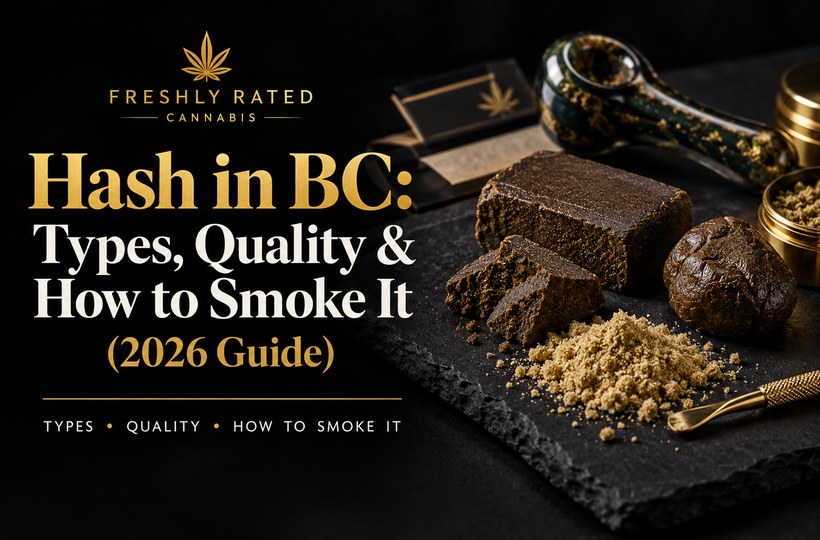
Hash has been around for roughly a thousand years, which makes every other concentrate on a BC menu a recent invention by comparison. Shatter, live resin, diamonds and distillate all arrived in the last few decades. Hash predates all of it, and it’s made without a single solvent.
It’s also the concentrate most people get wrong. They buy a gram, crumble it into a joint like it’s kief, get a disappointing smoke, and conclude hash isn’t for them. Usually the hash was fine and the handling wasn’t.
This guide covers the main types of hash you’ll find in British Columbia, how to judge quality before you’ve even smoked it, and the four methods that actually work for consuming it. If you want the wider view of how hash sits alongside shatter, budder and the rest, our full concentrate guide covers the whole category. This one goes deep on hash alone.
The short version
- Hash is pressed resin, not an extract. No butane, no CO2, no solvent of any kind.
- Two main production methods: dry sift and ice water. Ice water hash, usually called bubble hash, is the higher grade of the two.
- Quality shows before you smoke it. Colour, aroma, how it responds to heat and whether it bubbles tell you most of what you need.
- Warm it before you handle it. Cold hash crumbles badly or won’t break at all. Thirty seconds between your fingers fixes it.
- Don’t crumble good hash into a joint. A hash hole or a bowl topper gets far more out of it.
What hash actually is
Cannabis flower is covered in trichomes, the tiny resin glands that hold almost all of the plant’s cannabinoids and terpenes. Everything that makes cannabis potent and aromatic lives in those glands rather than in the plant material itself.
Hash is what you get when you separate those trichomes from the plant and press them together. That’s the entire concept. No chemistry, no solvent, no lab. You are mechanically collecting the resin and compressing it.
This is the fundamental split between hash and modern concentrates. Shatter, budder and live resin are made by dissolving cannabis in a solvent such as butane or CO2 and then purging the solvent off. That process can strip out more of the plant and produce higher THC numbers, which is why a shatter might test at 80% and a quality hash at 50% to 60%.
Lower on paper, but the experience is different in a way the percentage doesn’t capture. Hash retains more of the plant’s full profile, which is why people describe it as rounder and more complete rather than sharper. If you’ve only smoked solvent extracts, the difference is noticeable immediately.
The main types of hash
Dry sift
Dry sift is made by tumbling dried cannabis over fine mesh screens. The trichome heads break off, fall through the screen and collect underneath as a loose powder. That powder is kief. Press the kief under heat and pressure and it becomes dry sift hash.
Quality varies widely with how carefully it was screened. A careless sift carries a lot of plant matter through with the resin, which makes the hash greener, harsher and more likely to leave black ash. A well made dry sift is almost pure resin heads, blond to light brown, and burns clean.
Bubble hash (ice water extraction)
Bubble hash is made by agitating cannabis in ice water. The cold makes the trichome heads brittle so they snap off, and the resin is then filtered through a series of mesh bags of decreasing micron size. Each bag catches a different size fraction.
The name comes from the quality test: good bubble hash bubbles and melts when heated, rather than just smouldering. The bags are often labelled by micron rating, and the middle ranges around 73 to 120 micron typically hold the cleanest, most intact resin heads. You’ll also see a star rating from one to six, where five and six star material is considered full melt.
Our Lebanese Bubble Hash is an ice water product and currently the highest rated hash on our menu.
Traditional pressed and hand rubbed
Several regions have been producing hash by hand for centuries, and each has a recognisable character.
- Afghan style is dark, soft and pliable, usually pressed with a small amount of moisture. Deep, earthy and spicy. It tends to be the softest of the traditional styles, workable with warm hands alone.
- Moroccan style is lighter, often blond to tan, drier and more crumbly. Gentler and sweeter on the palate than Afghan. Our Kitty Blond Moroccan Hash is a blond pressed style.
- Lebanese style sits between the two, typically yellow to reddish brown, with a distinctive aged, slightly sweet aroma.
- Charas is hand rubbed from live plants rather than dried material, producing a very dark, sticky, pliable product.
We also carry Nordic Hash and Afghan Black Hash in the pressed category. Browse everything in the hash section.
Hash rosin
The modern solventless option. Hash rosin is made by pressing bubble hash between heated plates, squeezing the resin out of the trichome heads as an oil. It’s still solventless, but the texture and potency land much closer to a modern concentrate than to traditional hash.
Comparing the types
| Type | How it’s made | Texture | Typical colour | Best consumed |
|---|---|---|---|---|
| Dry sift | Screened dry, then pressed | Crumbly to firm | Blond to light brown | Bowl topper, hash hole |
| Bubble hash | Ice water agitation and filtering | Sandy to putty, melts with heat | Blond to caramel | Bowl topper, vaporizer, dab if full melt |
| Afghan style | Pressed, traditional | Soft, pliable | Very dark brown to black | Hash hole, bowl topper |
| Moroccan style | Sifted and pressed | Firm, crumbles when warm | Blond to tan | Bowl topper, crumbled into a joint |
| Hash rosin | Bubble hash pressed with heat | Oily, sappy | Light amber | Dab rig or vaporizer |
How to judge hash quality
You can tell a lot before you light anything.
Colour
Lighter generally means cleaner. Blond and light brown hash usually contains more pure resin and less plant matter. Very dark or green tinted hash often carries more vegetal material, though genuine aged Afghan styles are legitimately near black, so colour alone isn’t the whole story. Green specifically is the warning sign, not dark.
Smell
Quality hash smells rich and complex: spicy, earthy, sometimes floral or sweet depending on origin. It should smell like something. Hash that smells faint, dusty or like hay has either degraded or was made from poor starting material. Anything with a chemical or plastic note should be avoided outright.
The warmth test
Work a small piece between your fingers for twenty or thirty seconds. Good hash softens and becomes pliable, taking a fingerprint. Low grade hash stays hard and chalky, or crumbles into dust without ever becoming workable. Resin responds to heat; plant matter and filler do not.
The bubble test
Hold a small piece to a flame briefly. High quality resin bubbles, melts and produces thick white smoke. Lower grade material just catches and burns with a blacker ash. This is where the name bubble hash comes from, and it’s the quickest practical quality check there is.
Ash colour
After smoking, clean resin leaves pale grey to white ash. Dark black ash means you were smoking plant material and contaminants alongside the resin.
A note on pricing. Hash is one of the better value concentrates in BC. Single grams on our menu start around $12 to $13, and the 12 gram mix and match at $110 works out to roughly $9 per gram, which lets you try several styles rather than committing to one. The 6 gram option at $60 is the smaller version of the same idea. Trying three or four origins side by side teaches you more about what you like than any guide can.
How to smoke hash
This is where most people go wrong. Hash is denser than flower and needs air and sustained heat to burn properly. Pack it tight and it goes out; crumble it loose into a joint and it falls through.
1. On top of a bowl
The simplest method and the one to start with. Pack your bowl with flower as normal, then place a small piece of hash on top. The flower underneath gives the hash something to burn against and keeps airflow open.
Use a low flame and a gentle draw. Corner it rather than torching the whole bowl, which lets you take several hits instead of scorching it all at once.
2. The hash hole
A hash hole is a joint with a core of hash running down the middle. Roll the hash into a thin snake, lay it along the length of your flower before closing the joint, and the hash burns evenly inside rather than falling out.
If your hash is too soft to roll into a snake, chill it for a few minutes first. If it’s too hard, warm it in your hands. The technique is a small variation on standard rolling, so if you’re still building that skill our rolling guide covers the fundamentals.
3. Vaporizer
A dry herb vaporizer with a concentrate pad or a dedicated hash insert is the cleanest option, and it extracts the most from a given amount. Temperature control means you can stay below combustion and actually taste the terpenes, which is wasted when you apply a flame directly.
Around 190°C is a reasonable starting point for most hash. Start lower than you think and work up.
4. Dabbing, for full melt only
Only full melt bubble hash and hash rosin are suitable for a dab rig. Traditional pressed hash contains enough plant material that it will leave a burnt residue in your banger and taste acrid. If it doesn’t fully melt on the warmth and bubble tests, don’t dab it.
You may still see the old hot knife method mentioned in older guides. It involves heating metal blades red hot, and it’s an easy way to burn yourself badly for no advantage over any of the methods above. There’s no reason to use it.
Storing hash
Hash is more stable than flower, but it still degrades.
- Airtight and cool. A small glass jar in a drawer is ideal. Hash hardens and dries out when left exposed.
- Out of direct light. UV breaks down cannabinoids in resin the same way it does in flower.
- Not in the fridge, usually. Repeated condensation from taking it in and out causes more problems than the cold solves. Room temperature in a sealed container is better for anything you’re working through within a few months.
- Parchment, not plastic wrap. Soft hash sticks to plastic and you lose product to the wrapper.
The same storage principles that apply to flower apply here, and we covered those in more detail in our guide to cannabis shelf life and storage.
If it’s your first time with hash
Hash is meaningfully stronger than flower. A piece the size of a grain of rice on top of a bowl is a reasonable starting point, not a chunk the size of a pea.
Take one hit, wait ten minutes, and reassess. Inhaled cannabis comes on quickly, so there’s no reason to stack hits before you know where you are. People who find hash overwhelming have almost always used too much on the first attempt rather than reacted badly to hash itself.
If you’re coming from flower and want a sense of where hash sits on the potency scale relative to what you’re used to, our guide to BC’s AAAA grading system is a useful reference point.
Buying hash in BC with same day delivery
Cannabis is legal for adults 19 and over in British Columbia. We deliver hash, kief and the rest of our concentrate range same day across Surrey, the Lower Mainland and the Fraser Valley, seven days a week from 12:00 PM to 8:00 PM. Order by 7:45 PM for same day delivery.
Same day delivery is available in Surrey, Vancouver, Burnaby, Langley, Coquitlam, Richmond, Delta, New Westminster and more across the region. Check the full delivery zone for your area.
Shop hash with same day delivery
Traditional pressed, bubble hash and mix and match bundles, delivered across the Lower Mainland and Fraser Valley.
Frequently asked questions
Is hash stronger than weed?
Yes. Hash concentrates the resin from a much larger quantity of flower, so it typically tests considerably higher in THC than the bud it came from. Start with a very small amount.
What’s the difference between hash and kief?
Kief is the loose trichome powder collected from dried cannabis. Hash is that resin pressed together under heat and pressure. Kief is the ingredient; hash is the finished product.
Is hash the same as shatter?
No. Hash is made mechanically by separating and pressing resin, with no solvent involved. Shatter is made by dissolving cannabis in a solvent such as butane and then purging it off. Shatter usually tests higher in THC; hash retains more of the plant’s original character.
Why does my hash crumble instead of bending?
Usually temperature. Most hash needs warming before it becomes workable. Hold a piece between your fingers for twenty or thirty seconds. If it still won’t soften at all, it likely contains a high proportion of plant material rather than resin.
Can you put hash in a joint?
Yes, and the best way is a hash hole: roll the hash into a thin snake and lay it along the centre of the joint before closing it. Loose crumbs mixed through flower tend to fall out or burn unevenly.
What does full melt mean?
Full melt hash liquefies completely when heated rather than smouldering, which indicates very clean, intact resin with minimal plant material. It’s the only grade of traditional hash suitable for dabbing.
How should I store hash?
Airtight, cool and out of direct light. A small glass jar in a drawer works well. Use parchment rather than plastic wrap for soft hash, since it sticks to plastic.
Do you deliver hash same day in Surrey?
Yes. We deliver hash across Surrey and the wider Lower Mainland and Fraser Valley daily between 12:00 PM and 8:00 PM. Place your order by 7:45 PM for same day delivery.